Project Overview
This project was designed for a school that wanted to build a safe and friendly outdoor playground for young children. The school had students from preschool to lower primary grades. Many children used the outdoor area during morning breaks, lunch time, physical activity classes, and after-school programs.
Before the project started, the school had only a small outdoor activity area. The old equipment was simple and could not support many types of play. Some children liked climbing, some liked sliding, and some needed open space for movement. The school wanted a better playground that could help children play, learn, and build confidence in a safe outdoor space.
The client needed a complete playground equipment solution. The new playground had to be suitable for young children, easy for teachers to supervise, and strong enough for daily school use. Our team provided support from demand confirmation and design planning to production, packaging, and delivery.
Client Requirements
At the beginning of the project, the school shared the site size, user age range, and main project goals. The playground needed to be safe, colorful, and easy to use. The school wanted equipment that could encourage children to move more, play together, and develop basic physical skills.
The main requirements included:
- Playground equipment suitable for young children
- Safe play height and simple activity routes
- Climbing, sliding, balancing, and interactive play functions
- Bright colors that matched the school environment
- Durable materials for daily outdoor use
- Clear layout for teacher supervision
- Reliable packaging and delivery support
The school also wanted the playground to support group play. Children should be able to use different parts of the equipment at the same time without making the area too crowded.
Design Solution
After reviewing the project needs, our design team prepared a playground layout for the school. The design focused on safety, simple movement, and age-appropriate play. Since the users were young children, the equipment height was kept friendly, and the play routes were designed to be easy to understand.
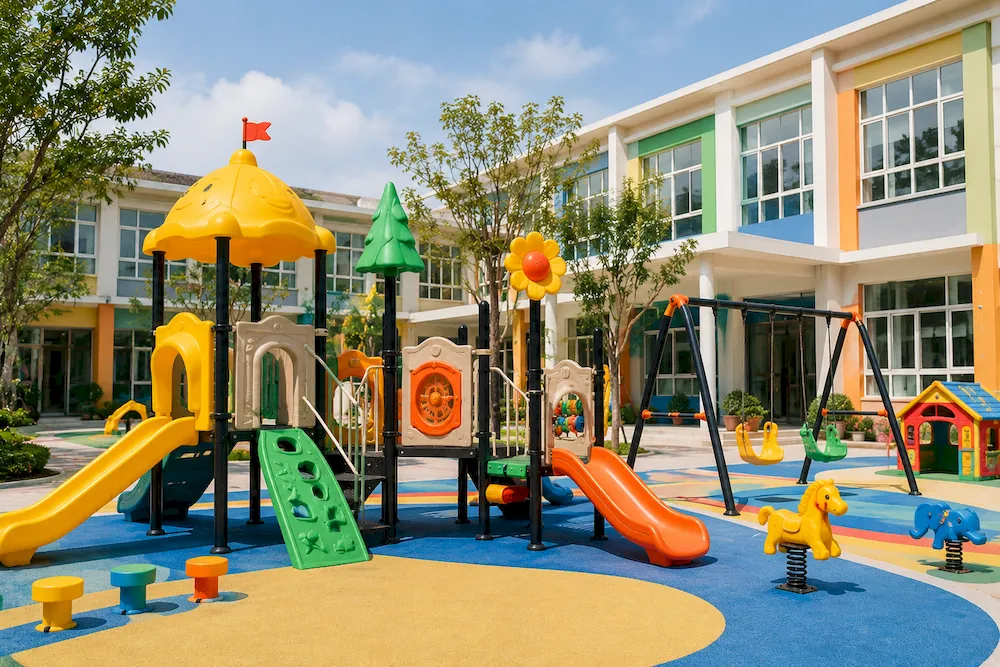
The final solution included a main play structure, slides, climbing panels, small platforms, guardrails, and balance elements. The colors were bright but not too complex. This helped create a happy school playground while keeping the overall design clean and organized.
Main Play Functions
The playground included several play activities:
- Low climbing areas for young children
- Slides with suitable height and safe exit space
- Small platforms for movement and role play
- Guardrails for better safety on raised areas
- Balance and stepping elements for body control
- Open space around the equipment for easier movement
The layout allowed children to move from one play function to another naturally. Teachers could also see most of the playground from nearby positions, which made supervision easier during school hours.
Safety Planning
Safety was the most important part of this school playground project. Young children need equipment that is easy to use and not too difficult. If the equipment is too high or too complex, it can create safety problems. Because of this, our design team paid attention to platform height, climbing difficulty, slide direction, and the space around each activity area.
The playground was designed with clear entry and exit points. The slide exit area was kept open, and climbing areas were placed away from the busiest movement paths. Guardrails and support structures were included where needed.
Safety Details Considered
- Age-appropriate equipment height
- Smooth edges and child-friendly structure
- Stable support posts and strong connections
- Clear space around slides and climbing areas
- Easy supervision for teachers and staff
- Simple play routes for younger children
These details helped the school create a play environment that was both fun and easier to manage.
Material Selection
For school playground equipment, the materials must be durable, safe, and suitable for repeated daily use. Children use school playgrounds many times every week, so the equipment needs to handle regular activity, weather changes, and long-term outdoor exposure.
For this project, the main structure used outdoor-friendly materials with strong support parts. Plastic play components were used for slides and selected accessories. Metal connectors and support parts were chosen for stability. The surface treatment was also considered to make the equipment more suitable for children’s use.
The final material combination helped balance safety, appearance, cost, and long-term use. It also made the playground easier for the school to maintain.
Production Process
After the school confirmed the design and product list, the project entered production. Our production team prepared the main materials, processed the structural components, checked the accessories, and arranged quality inspection before packaging.
Because this playground was for young children, the production team paid close attention to product details. Components needed to match the confirmed design, and the surface condition needed to be checked before packing.
The production process included:
- Confirming final drawings and equipment list
- Preparing structural materials and play components
- Processing main parts according to the design
- Checking dimensions and surface quality
- Preparing accessories and hardware
- Sorting parts for easier installation
- Packaging products for delivery
Each step helped reduce possible problems during installation and use.
Packaging and Delivery
The playground equipment included different types of components, including structural parts, slides, panels, connectors, and hardware. To make the installation process easier, the parts were sorted and packed carefully.
Large components were protected with suitable packing materials. Smaller accessories and hardware were packed separately and clearly organized. The goal was to protect the goods during transportation and help the school’s installation team identify the parts more easily after delivery.
Our team also supported the client with packing information and delivery coordination. This helped the school plan the receiving and installation schedule in advance.
Installation Support
The installation work was handled by the client’s local team. Before installation, the school prepared the ground area and checked the product parts after arrival. Our team provided basic installation guidance, product information, and communication support when needed.
Since this was a school project, the installation schedule had to avoid normal teaching time as much as possible. Good planning helped reduce disruption to school activities. After the equipment was installed, the school checked the structure and cleaned the play area before opening it to children.
Final Result
After the project was completed, the school had a new outdoor playground designed for young children. The new play area gave students more ways to move, play, and interact with each other. Children could climb, slide, balance, and explore in a space made for their age group.
Teachers also found the layout easy to supervise. The playground created a better outdoor activity area for daily school life. It became a place where children could build physical skills, improve confidence, and enjoy time outside.
Project Highlights
- Age-appropriate playground design for young children
- Safe layout with clear play routes
- Multiple activity functions in one school play area
- Durable materials for daily outdoor use
- Simple supervision for teachers and school staff
- Clear production, packaging, and delivery support
Why This Project Was Successful
This project was successful because the playground was designed around the real needs of a school. The goal was not only to install equipment, but to create a safe and useful outdoor learning and play environment for young children.
The design focused on simple movement, safe play height, and easy supervision. The material selection and production process also supported long-term use. Good communication between the school and our team helped keep the project clear from the first design discussion to final delivery.
The final playground gave the school a better outdoor space and gave children more chances to play actively during the day.
Conclusion
The School Playground Equipment Project for Young Children shows how a well-planned playground can improve a school’s outdoor environment. With the right design, materials, safety planning, production, and delivery support, a simple outdoor area can become a valuable play space for students.
For schools, kindergartens, childcare centers, and learning campuses, a customized playground solution can support children’s physical growth, social interaction, and daily activity. Our team will continue to help education projects create safe, practical, and enjoyable outdoor playground spaces.